Python 3.15 Is Feature-Frozen: The Practical Features Developers Should Know
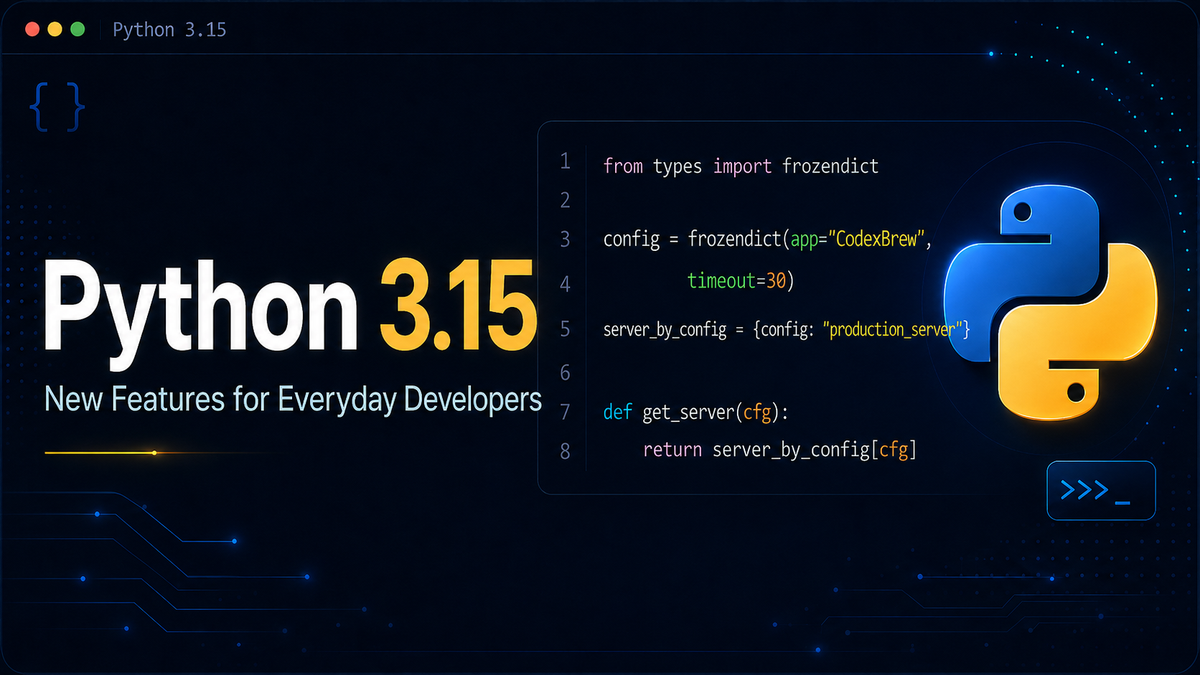
Python 3.15 is now feature-frozen, which means the major language changes are locked and ready for developers to start testing and it is shaping up to be a practical release focused on everyday developer pain points: faster startup with lazy imports, better profiling tools, safer immutable configuration objects, cleaner default values, UTF-8 by default, and smarter error messages.
That makes Python 3.15 especially interesting for people who build real systems: command-line tools, APIs, data pipelines, backend services, ML workflows, and large applications with heavy dependencies.
Here are the changes I found most useful for my day-to-day workflow, especially when thinking about backend architecture and system design.
1. Lazy Imports
Large Python projects often start slowly because expensive libraries are imported before they are actually needed.
Today, developers usually move imports inside functions:
def run_model():
    import pandas as pd
    import torch
That works, but it can make code harder to organize.
Python 3.15 introduces explicit lazy imports, allowing heavy modules to stay at the top of the file while loading only when used.
lazy import pandas as pd
lazy from heavy_ml_library import ComplexModel
This is especially useful for CLIs, ML tools, and large backend services where startup time matters.
2. Tachyon: A New Built-In Sampling Profiler
Python 3.15 adds a new profiling package, including profiling.sampling, also known as Tachyon.
Tachyon is a low-overhead statistical profiler. Instead of tracking every function call, it samples a running Python process and shows where the program is spending time.
You can run it against a script:
python -m profiling.sampling run script.pyOr attach it to an already-running process:
python -m profiling.sampling attach 12345That makes it useful for real-world debugging: slow APIs, background jobs, workers, data pipelines, and long-running services. Instead of guessing where performance problems are coming from, Python 3.15 gives developers a more practical way to inspect what is actually happening.
3. Frame Pointers Improve Production Observability
Python 3.15 also enables frame pointers by default on supported platforms.
This is a low-level change, but it helps profilers and observability tools produce better stack traces. That matters when Python code interacts with C extensions, ML libraries, database drivers, or other native components.
You probably will not change your code because of frame pointers. But when a production service is slow, stuck, or difficult to profile, this change can make debugging much easier.
4. Native [Immutable] frozendict
Python has set and frozenset, but dictionaries have always been mutable by default. That creates problems when dictionaries are used for configuration, constants, or cache keys.
Python 3.15 adds a native immutable dictionary:
# Python 3.15 Syntax
CONFIG = frozendict(api_version="v2", timeout=30)

# This will immediately raise a TypeError:
CONFIG["timeout"] = 60

# Since all keys and values are hashable, this is now completely valid:
database_keys = {CONFIG: "production_cluster"}
This makes configuration safer and easier to reason about.
5. Built-In sentinel
Python developers often need to distinguish between:
- A user passed
None - A user passed nothing at all
The old pattern looks like this:
_MISSING = object()It works, but it is awkward in tracebacks, typing, and serialization.
Python 3.15 adds a cleaner built-in sentinel pattern:
MISSING = sentinel("MISSING")

def update_profile(user_id: int, bio: str | MISSING = MISSING):
    if bio is MISSING:
        print("No bio was provided.")
This is a useful improvement for API design, data validation, and optional fields.
I have been working on a side project for a few months now. I was applying everything I’ve learned over the last few years and having fun until something I only ever expected to see in the movies happened to my site.
6. Cleaner Comprehension Unpacking
Python 3.15 also improves unpacking inside comprehensions.
# Instead of writing nested loops to flatten lists:
flattened = [item for sublist in nested_lists for item in sublist]

# You can write:
flattened = [*sublist for sublist in nested_lists]

# Dictionary merging also becomes cleaner:
merged_config = {**d for d in list_of_dicts}
The goal is simple: make common data transformations easier to read.
7. UTF-8 by Default
Python 3.15 moves standard file I/O toward UTF-8 by default across platforms.
That helps reduce classic encoding problems, especially when code behaves differently on macOS, Linux, and Windows.
8. Better Error Messages
Python 3.15 also improves error messages, especially when developers accidentally use patterns from other languages.
# For example, a JavaScript developer might write this:
items = [1, 2, 3]
items.push(4)

# Instead of only saying that list has no attribute push, Python can now suggest the Python equivalent:
AttributeError: 'list' object has no attribute 'push'. Did you mean '.append'?

# Another common example:
name = "python"
name.toUpperCase()

# Python can guide the developer toward the correct string method:
AttributeError: 'str' object has no attribute 'toUpperCase'. Did you mean '.upper'?
This may sound small, but it matters. Better errors reduce debugging time, help beginners learn faster, and make Python friendlier for developers switching from JavaScript, Java, Ruby, or C#.
Final Thought
Python 3.15 looks like a release built for working developers and it is not just about performance; it is about removing small frustrations that appear again and again in real projects.
It improves typing, configuration safety, profiling, error messages, and more. These may not all sound flashy on their own, but together they make Python cleaner, safer, and easier to use in production.
Do not move production workloads blindly to a beta release, but start testing Python 3.15 in CI, local tooling, and compatibility checks. Library maintainers should test early because syntax changes like lazy imports may require updates in linters, type checkers, and code analyzers.